

ABOUT THE CONFERENCE
MUN stands for Model United Nations, which already hints at the general idea behind MUN conferences: To simulate the work of the United Nations, its sub-organs and related bodies in a realistic manner.
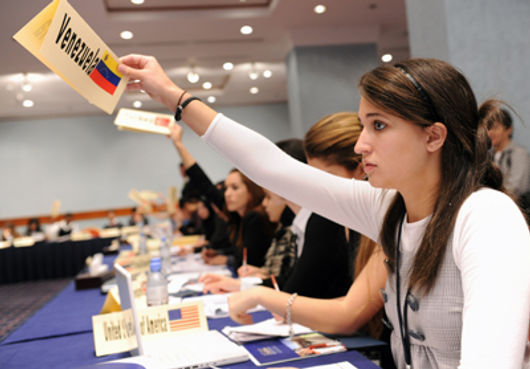
Each participant acts as a diplomat (delegate), representing the policy of an assigned country. A delegate’s aim is to act in the strategic interest of his/her country at all times. In simulated committees like the Security Council or the General Assembly, they debate current global issues throughout the scope of a conference which lasts from one day up to a week. They try to find comprehensive solutions while applying certain rules of procedure, similar to those of the UN. The topics of debate are also similar to those discussed by the UN. Work in committees is twofold: On the one hand, it consists of formal debate, where delegates hold speeches in front of the council and vote on decisions. On the other hand, they meet during informal ‚caucus’ time, where they can freely negotiate one-to-one and work on drafts for a final resolution. At the end of the conference the delegates have written and voted on resolutions that tackle the discussed problems.
The purpose of MUN conferences is that participating students may experience what it means to act diplomatic, to consider national strategic interests and how difficult it is to find comprehensive solutions in global politics. They improve their knowledge about other countries and international relations as well as their rhetorical and diplomatic skills. MUN conferences are held on a local level (i.e. within a school or university), a regional level (i.e. within a city or country) or even on a global scale, like the NMUN in New York or the WorldMUN in alternating cities.

For any queries:
vp.krmun@vp.krmangalam.com